Nadia’s attempted suicide and Jack’s rescue
Anxious PeopleNadia’s attempted suicide and Jack’s rescue is a formative event whose consequences reach far beyond the bridge: it redirects Nadia toward a life spent helping people in crisis, fixes Jack’s ambition to become a police officer, and leaves Zara with a memory she cannot bring herself to speak about for a decade.
Causes and Background
Nadia had long felt isolated from everyone around her, even while sitting among classmates or at the family dinner table. Her distress was invisible to the people beside her, and she did not tell them what she was experiencing. The account compares her inner life to a forest growing so dense that sunlight could no longer penetrate it. As a child, she had also become afraid of drowning after an adult told her that a drowning person might be unable to call or wave for help. The image stayed with her: a person sinking while others nearby failed to understand what was happening.
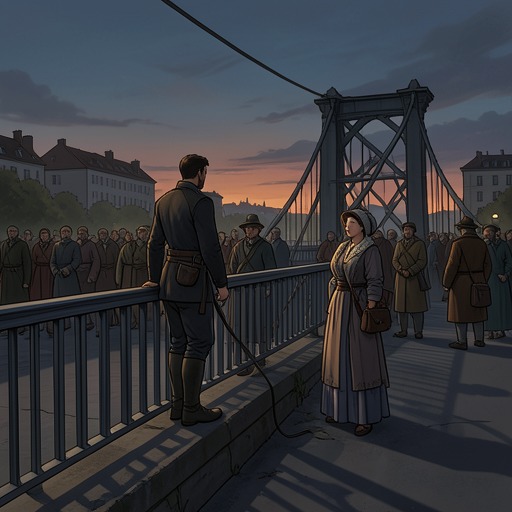
On the day of the attempt, Nadia did not go to school. She tidied her room, made her bed, and left home without a coat because she did not expect to need one. She spent the day wandering around town, feeling as if she wanted the town to see her once more and recognize what its failure to hear her had meant. She had no settled plan, only what she understood as a consequence. At sunset, she found herself on the bridge railing, believing that a fall into the water would mean impact rather than drowning. The thought eased her fear of the moments before death; moving one foot and then the other seemed frighteningly simple.
The Rescue
Jack was a teenage boy who had been returning to the bridge evening after evening for a week. His parents had forbidden him to go, but he continued to sneak out, apparently hoping to see the man who had jumped there earlier and somehow undo what had happened. When he saw Nadia on the railing instead, he could not think of anything to shout. He rushed over and pulled her down. The force of the rescue knocked Nadia unconscious when the back of her head hit the tarmac.
Zara was also at the bridge, though Nadia and Jack did not know it. Zara had been standing hidden in the darkness and shaking as she watched the girl on the railing and the boy run to her. She did not intervene. She remained there until an ambulance arrived and took Nadia to hospital, then went out onto the bridge and found Nadia’s wallet and identification. That was how she learned the girl’s name.
Immediate Aftermath
Nadia woke in hospital with the back of her head bleeding. She had only caught a glimpse of the boy rushing toward her, and when nurses asked what had happened, she was unsure how to explain it. She told them she had climbed onto the railing to photograph the sunset and fallen backward. Accustomed to saying what other people wanted to hear so they would not worry, she gave the explanation without thinking. The nurses remained suspicious, but accepted the story as an accident; Nadia agreed with them that she had been lucky.
She could have gone straight back to the bridge after leaving hospital, but she did not. She could never know what she would have done if Jack had not pulled her down, or whether she would have taken a step forward or back. That uncertainty stayed with her. Rather than resolving the question, the rescue left her with a life to build around it.
Lives Redirected
Nadia’s attempt led her to keep trying to understand the difference between herself and the man who had jumped. She chose psychology as a profession and became a psychologist. The people who came to her were often in so much pain that they seemed to her to be standing with one foot over an edge; she met them with the recognition of someone who had been there herself. Her experience did not make her free of anxiety. She learned ways to cope and to carry it, and came to believe that people should be treated kindly, even when they are difficult, because the weight they bear may not be visible.
Jack never saw Nadia again and never returned to the bridge. But the rescue made his plan to become a police officer unshakable: he had discovered that he could make a difference. Years later, he would describe a different kind of limit to his ability to save people. He could not help his sister, and he could not save the man on the bridge; those left behind still had to get up the next day and continue their work. His mother had earlier taught him that help can only be given one bit at a time, and that people must do what they can when the chance comes. The rescue is an early, concrete instance of that principle, not a promise that every crisis can be prevented.
Zara’s Witness and the Event’s Afterlife
Zara never approached Nadia after the rescue. For ten years she secretly followed Nadia’s education and the beginning of her career from a distance, afraid to seek her out and afraid of what she might learn about herself. She wondered what separated the man who jumped from the girl Jack saved, while believing that she herself bore guilt. The letter left by the man who had jumped remained unopened in Zara’s possession; it was bound up with the bridge, the rescue, and the question she could not yet face.
Nadia’s later work also carried the event’s concern for people left alone by suicide into practical support. She went each year to a summer camp for children who had lost a family member to suicide, where the children could share the experience of being left behind rather than carry guilt, shame, and silence by themselves. Nadia listened, spoke when useful, and made room for laughter. The rescue did not erase Nadia’s earlier suffering or settle every question Zara had carried away from the bridge. Its lasting significance lies instead in the lives and forms of care that grew from a moment when Jack reached Nadia in time.